

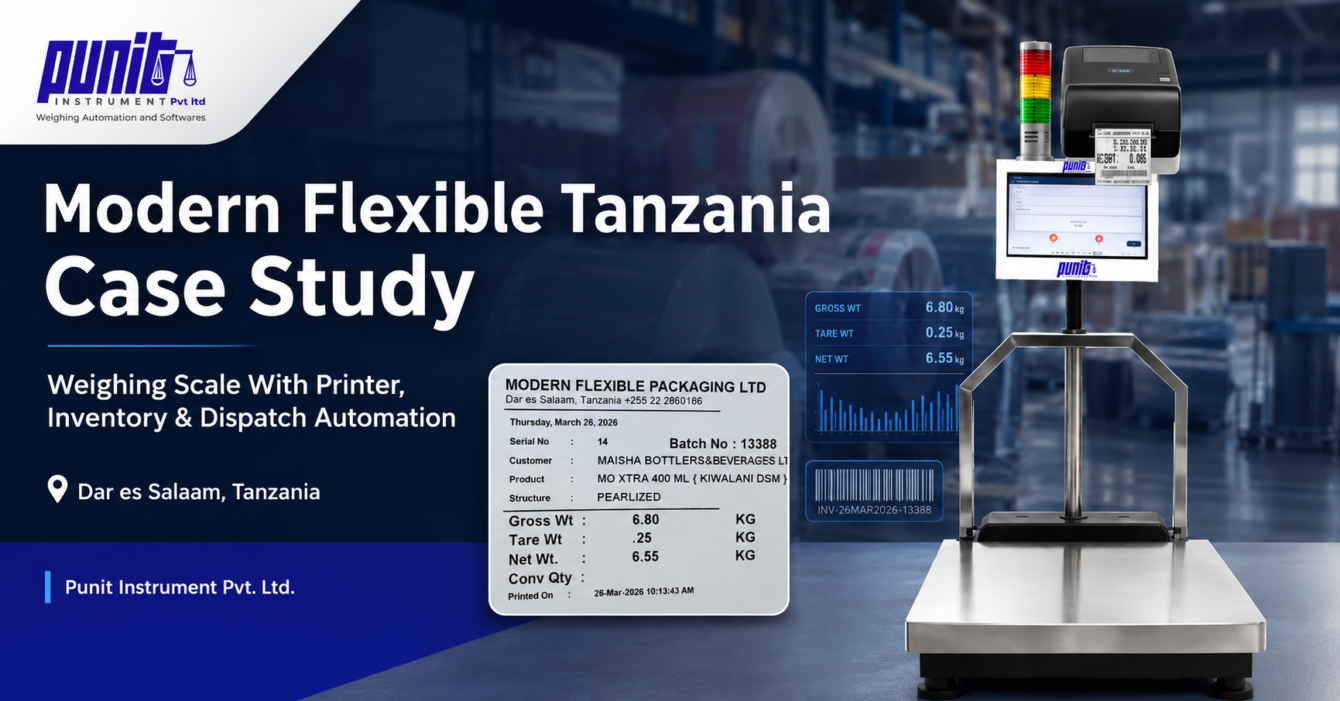
How Modern Flexible Packaging Tanzania Automated Weighing, Label Printing, Inventory and Dispatch With Punit Weighing Scale With Printer
Modern Flexible Packaging Ltd, Dar es Salaam, Tanzania needed to replace a highly manual weighing process across its flexible-packaging operations. Weight was being read from multiple weighing scales and then written by operators into paper registers. Product records, roll weights, inventory and dispatch information were maintained separately, creating repeated manual work and a high possibility of human error.
Punit Instrument Pvt. Ltd. implemented a connected weighing scale with printer, barcode labelling, cloud inventory and dispatch system that converts every physical weighment into a digital transaction.
Today, the operator places the material on the scale, selects the product on the touchscreen and the system captures the live weight automatically. A customised label is printed with product information, gross weight, tare weight, net weight and a unique barcode. The same transaction is saved in Punit ERP, added to inventory and remains traceable until the barcode is scanned during dispatch.
This case study explains how a weighing scale with printer and inventory management can eliminate handwritten weight records, create accurate roll-wise inventory and automate packing-list generation for flexible packaging manufacturers.
About Modern Flexible Packaging Ltd, Tanzania
Modern Flexible Packaging Ltd is a packaging manufacturer based in Dar es Salaam, Tanzania. Tanzania’s Small Industries Development Organization lists the company as a supplier/manufacturer of multilayer flexible-packaging laminates including PET-Poly, PET-MetPET-Poly, BOPP-BOPP and other laminate combinations used for products such as biscuits, candies, chocolates, snacks and other packaged goods.
For this project, Modern Flexible Packaging informed Punit instrument Private Limited that its operation spans multiple production facilities and handles approximately 500 metric tonnes of material per month. The weighing automation requirement covered both raw-material and finished-goods operations.
The Existing Problem: Accurate Scales, but Manual Weight Records
Modern Flexible already had multiple weighing scales across its plants. The core problem was not the ability to measure weight. The problem was what happened after the weight appeared on the display.
Operators were required to read the weight and manually write it into registers. In the raw-material plant, polymer granules and related material were weighed and recorded manually. In the finished-goods area, manufactured rolls were weighed individually and their details were again written by hand.
Because the company had many weighing points and approximately a dozen scales involved in different processes, the same basic issues were repeated across the facility:
- Weight had to be copied manually from the weighing scale.
- Product and batch information was written separately.
- Roll-wise inventory was difficult to maintain accurately.
- Management reports depended on handwritten records.
- Physical stock and recorded stock could differ.
- Dispatch required another round of manual checking.
- Preparing packing lists required collecting information from multiple records.
- Supervisors had limited real-time visibility of material already produced or dispatched.
Manual recording also created a usability problem. Shop-floor operators had different levels of literacy and computer familiarity. The automation therefore could not depend on complicated data-entry screens or require operators to type long product descriptions in English.
The Objective
Punit instrument Private Limited defined the project around a simple goal:
Make weighing automatic, make identification simple, make inventory reflect the actual physical material, and make dispatch traceable without depending on handwritten records.
The system had to be easy enough for a shop-floor operator to use with minimal interaction while still giving management detailed cloud reports and inventory visibility.
The Punit instrument Private Limited ‘S Solution
Punit Instrument Pvt Ltd supplied and exported a complete weighing scale with printer and inventory management system to Tanzania.
The implementation combined:
- Industrial weighing scale
- Touchscreen operator interface
- Barcode label printer
- Product and batch selection
- Automatic stable-weight capture
- Gross, tare and net weight recording
- Unique barcode generation
- Cloud-based Punit ERP
- Barcode-wise inventory
- Barcode scanner for dispatch outward
- Packing-list generation
- Automatic management reporting
- Customer-specific software workflow
The weighing station became a simple operational terminal rather than a full ERP screen. Operators receive only the access and controls needed for their weighing task, while administrators use the cloud panel for products, inventory, reports, dispatch and management functions.
Step 1: Product or Roll Is Placed on the Weighing Scale
The operator places the flexible-packaging roll, raw material or required item on the Punit weighing scale.
The live weight is captured directly from the weighing indicator by the Punit application. The operator does not need to read the display and type the number manually.
This is one of the most important differences between a conventional weighing machine and a connected digital weighing scale with printer. The weight used on the label, in the production record and in inventory comes from the same captured weighment.
Step 2: Operator Selects the Product on the Touchscreen
The touchscreen is configured around the actual Modern Flexible workflow. The operator selects the product or required production information using a simplified screen.
The interface can be restricted so the operator only sees the fields required for the weighing activity. Product masters, administrative configuration and management reports remain controlled from the Punit ERP admin panel.
This was particularly important because the system had to be practical for local shop-floor users with limited English and different levels of computer experience.
Step 3: Barcode Label Prints With Real-Time Weight
After the transaction is completed, the connected printer generates the product label.
The actual Modern Flexible label used in the project includes information such as:
- Serial number
- Batch number
- Customer
- Product
- Product structure
- Gross weight
- Tare weight
- Net weight
- Quantity information
- Date and time
- Barcode / transaction identity
The label photograph from the implementation shows a Modern Flexible Packaging Ltd label for a finished product with customer, product structure, batch number, gross, tare and net weight printed directly as part of the transaction.
This changes the weighing station from a simple scale into a weighing machine with barcode printer and digital record-creation point.
Step 4: Every Weighed Roll Automatically Becomes Inventory
Assume an operator weighs 100 finished rolls in one production batch.
With the Punit instrument Private Limited system, these are not merely 100 printed labels. The system creates 100 linked digital transactions.
For every roll, Punit ERP can maintain:
- Unique barcode
- Product
- Batch
- Customer or order information where applicable
- Actual weight
- Gross / tare / net values
- Date and time
- Operator
- Inventory status
- Dispatch status
As the rolls are weighed and accepted, their actual weight is added to finished-goods inventory. Management can therefore see both the number of rolls and their real recorded weight in the cloud dashboard.
This is the key advantage of a weighing scale with inventory management: stock is created from the physical material that was actually weighed rather than from a separate manually entered quantity.
Step 5: Cloud Inventory Shows What Is Physically Available
Once the rolls are transferred to the warehouse, administrators can open Punit ERP and view current inventory.
Instead of asking the warehouse team to count registers or consolidate spreadsheets, management can review:
- Product-wise stock
- Batch-wise inventory
- Barcode-wise rolls
- Roll count
- Actual total weight
- Available stock
- Dispatched stock
- Production history
- Dispatch history
This makes the weighing transaction the foundation of the inventory record.
Step 6: Dispatch Is Performed by Scanning the Barcode
When Modern Flexible receives a customer order, the warehouse team prepares the required rolls for dispatch.
Instead of manually writing every roll number and weight again, the operator scans the barcode already printed on each roll label.
The Punit dispatch screen verifies the scanned item and can confirm that the roll is currently available in inventory.
Every successful scan adds the roll to the dispatch transaction.
Step 7: Inventory Is Deducted Automatically
Once the outward transaction is confirmed, the selected rolls are deducted from available inventory.
For example, if 100 rolls are available and 20 approved rolls are scanned for dispatch, those exact barcode identities and their exact recorded weights can move from available stock to dispatched status.
There is no need for a second employee to manually deduct the weights later.
This provides far stronger control than maintaining only a product-level stock number because management can identify the physical rolls behind the inventory figure.
Step 8: Packing List Is Generated From the Rolls Actually Scanned
As rolls are scanned for dispatch, the system can generate the packing list from the actual outbound transactions.
A packing list may contain:
- Customer
- Product
- Batch
- Roll / serial number
- Barcode
- Individual roll weight
- Total number of rolls
- Total dispatch weight
- Date and time
- Other customer-specific fields
Because the document is generated from scanned inventory rather than manually typed afterwards, the packing list is directly connected to the material selected for outward.
The packing list can be emailed automatically to management and, where configured, to the customer.
Step 9: Management Gets Real-Time Dispatch Visibility
While the warehouse labour team completes the physical outward process, the administrator can monitor the transaction from the Punit ERP cloud panel.
The dashboard can reflect:
- What has been produced
- What has been weighed
- What is currently in inventory
- What has been dispatched
- Which customer received the goods
- The weight associated with the transaction
- Batch-wise and product-wise history
This changes weighing data from a local shop-floor reading into a management information source.
Before vs After Punit Weighing Automation
| Process | Before | After Punit |
|---|---|---|
| Weight Recording | Handwritten from scale display | Automatic live weight capture |
| Product Label | Separate/manual process | Printed immediately after weighing |
| Gross / Tare / Net | Written or calculated manually | Stored and printed digitally |
| Barcode | Not connected to weighment | Unique barcode linked to transaction |
| Production Records | Paper registers | Cloud transaction history |
| Inventory | Manual reconciliation | Updated from actual weighments |
| Dispatch | Manual roll checking | Barcode scan-based outward |
| Packing List | Prepared manually | Generated from scanned rolls |
| Management Visibility | Delayed | Cloud-based reporting |
| Multi-Plant Scalability | Separate records | Centralized software architecture |
Why This Matters for Flexible Packaging Manufacturers
Flexible packaging manufacturing often involves material that changes form through production: polymer granules become film, rolls are converted, slit, laminated, printed or finished, and finished rolls are eventually dispatched to customers.
Weight is one of the most important common data points across this process.
When weight is handwritten, every downstream system depends on a manually copied number. But when the scale itself creates the digital transaction, the same verified data can feed:
- Labels
- Production records
- Inventory
- Warehouse transactions
- Packing lists
- Dispatch
- Management reports
- ERP integration
For manufacturers looking for an industrial weighing scale with printer, the real value is therefore not only the printed sticker. It is the digital process created around every weighment.
Designed for Easy Shop-Floor Operation
Automation only works when operators can actually use it.
For Modern Flexible, one of the project requirements was to reduce dependency on typing and English-language data entry. The weighing-side application therefore focuses on a simple operator workflow.
Typical operator interaction is reduced to:
- Select the required product or order.
- Place the roll/material on the scale.
- Allow the system to capture stable weight.
- Print the label.
- Move the labelled product to storage.
For dispatch:
- Select the customer/order.
- Scan each roll barcode.
- Confirm outward.
The complex reporting, stock analysis and configuration remain in the administrator interface.
From Weighing Scale With Printer to Full Weighing ERP
The initial implementation solved the immediate requirement of weighing, labelling, inventory and dispatch traceability. The project is now evolving toward a broader customized ERP workflow for Modern Flexible.
This is how Punit approaches weighing automation projects: start from the physical weighing point, connect the transaction digitally and then expand the system around production, inventory, dispatch and enterprise requirements.
The same architecture can be extended to:
- Raw-material inward
- Recipe or batch production
- Mother-roll and finished-roll traceability
- Wastage tracking
- Warehouse locations
- Customer orders
- Production planning
- Quality-control fields
- Multi-location dashboards
- SAP / ERP integration
SEO-Relevant Questions About This System
Can a weighing scale print barcode labels automatically?
Yes. Punit’s weighing scale with barcode printer can capture live stable weight and print a customised label containing product details, gross, tare, net weight, date, batch and a unique barcode or QR code.
Can a weighing scale update inventory automatically?
Yes. With Punit’s inventory module, an accepted weighment can create a barcode-wise inventory record. When that barcode is scanned during dispatch, the exact item and its weight can be deducted from stock.
Can a weighing machine generate a packing list?
The weighing scale itself captures the physical transaction, while Punit software combines the scanned dispatch records into a packing list containing the selected products, rolls, quantities and weights.
Can an existing factory use multiple weighing scales with one software system?
Yes. Compatible weighing stations can be connected to a centralized database so that multiple production or warehouse locations report into one management system.
Is a weighing scale with printer useful for flexible packaging?
Yes. Flexible-packaging manufacturers can use the system for raw-material weighing, roll identification, gross/tare/net labels, barcode-wise inventory, warehouse tracking, dispatch outward and packing-list generation.
Relevant Punit Solutions
Explore the systems used to build similar automation projects:
- Punit Weighing Scale With Printer
- Weighing Scale With Printer & Inventory Management
- Industrial Weighing Scale With Printer
- Punit Weighing Automation Solutions
Conclusion
The Modern Flexible Packaging Tanzania project demonstrates what happens when weighing is treated as more than a number on a display.
By connecting the scale with touchscreen software, barcode label printing, cloud inventory and scan-based dispatch, Punit converted a manual, paper-dependent process into a connected workflow.
Every roll can now move through a simple digital chain:
WEIGH → PRINT → RECORD → INVENTORY → SCAN → DISPATCH → PACKING LIST → REPORT
For flexible packaging, polymer, film, roll, warehouse or manufacturing companies searching for a weighing scale with printer, barcode weighing scale, weighing scale with inventory management or complete weighing automation, this case study shows the value of connecting the physical scale directly with the business process.
Punit Instrument Pvt. Ltd.
Weighing Automation & Software Since 1999
www.punitinstrument.com
+91 97253 53523