
What Are Calibration Weights? How to Find the Right Calibration Weight for Your Business

Intro
Calibration weights are precision-made reference masses used to check and adjust the accuracy of weighing machines from small laboratory balances to large industrial weighbridges.
They ensure that every reading you take is accurate, traceable, and compliant with international measurement standards.
This guide will help you understand:
- What calibration weights are and how they work
- The difference between CI, Cast Iron, and Bullion weights
- How to choose the right calibration weights for your business
If you’re short on time:
Calibration weights are standard certified weights used to test and adjust scales.
Choose M1 class for industrial use and F1/F2 class for laboratory or precision weighing.
What Are Calibration Weights?
A calibration weight is a certified standard mass used to test, verify, and calibrate weighing instruments. When you place a calibration weight on a scale, it allows you to check whether that scale reads correctly.
If the reading differs from the actual certified weight, you can adjust the instrument to restore accuracy.
In simple terms Calibration weights make sure your weighing scale tells the truth. They form the foundation of accuracy for factories, laboratories, research centers, and quality control departments worldwide.
Why Are Calibration Weights Important?
Every business that relies on weight-based measurement from a food packaging plant to a gold testing lab needs calibration weights.
Even a tiny measurement error can cause:
- Production rejections
- Wrong billing or material loss
- Non-compliance with ISO or NABL standards
- Damaged brand trust
Using certified calibration weights ensures that your weighing results are accurate, consistent, and legally traceable to national standards.
In short:
Calibration weights protect your quality, compliance, and profitability.
How Does Calibration Work?
Calibration is a comparison process between a known reference weight and the reading shown by your weighing instrument.
Here’s how it works step-by-step:
- You place a certified calibration weight on your weighing scale.
- The scale reading is compared to the actual known mass.
- If a difference exists, the scale is adjusted until the reading matches.
- Once done, the scale is “calibrated.”
This process ensures your weighing instruments remain accurate and audit-ready at all times.
What Are Calibration Weights Made Of?
Calibration weights come in different materials, each suited to specific environments:
| Material | Common Use | Characteristics |
|---|---|---|
| Stainless Steel | Laboratories, Pharma | Corrosion-resistant, highly accurate |
| Cast Iron (CI) | Industrial use, Factories | Heavy-duty, durable, affordable |
| Brass | Educational or low-capacity applications | Non-corrosive but less durable |
| Non-magnetic Stainless Steel | Precious metal & jewelry industries | Highly stable, mirror-polished finish |
Understanding the various types of weighing scales ensures optimal selection for specific applications. So Choosing the right weighing scale can transform your operations
Difference Between CI Weight, Cast Iron Weight, and Bullion Weight
Many people confuse these three CI weight, cast iron weight, and bullion weight because they sound similar.
However, their accuracy, use case, and certification are entirely different.
Below is a simple explanation:
A. CI Weights (Cast Iron Weights for Industrial Calibration)
CI Weights (short for Cast Iron Weights) are the workhorses of industrial calibration.
They are made from solid cast iron and designed for high-capacity weighing perfect for platform scales, weighbridges, and warehouse scales.
Key Features:
- Accuracy Class: M1 or M2 (OIML standard)
- Material: Cast Iron
- Finish: Painted black, anti-corrosive coating
- Range: 1 kg to 500 kg or more
- Certification: Optional (some uncertified models exist)
They are ideal for environments where toughness and weight stability matter more than micro-level precision.
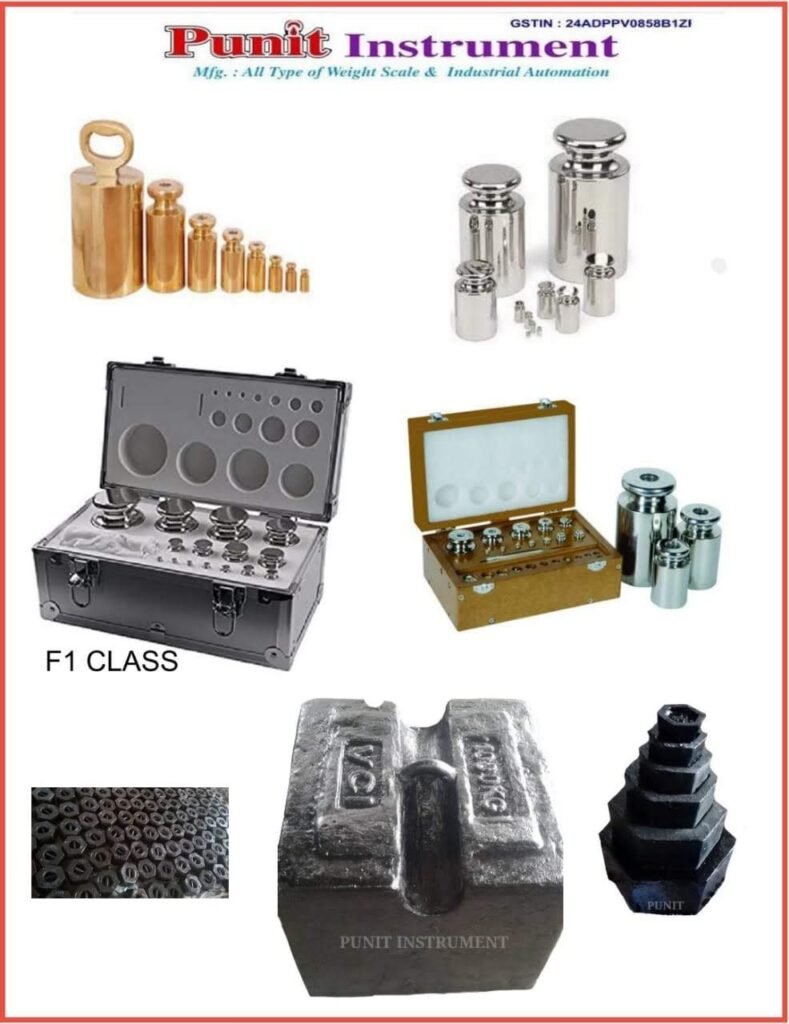
B. Cast Iron Calibration Weights (Certified CI Weights)
Although CI weights and Cast Iron Calibration Weights share the same base material, certified calibration weights undergo precision machining, polishing, and BIS verification to ensure exact tolerances.
Key Features:
- Accuracy Class: M1 / M2
- Certification: BIS IS 10536:2018 compliant
- Traceability: Each weight has a serial number and calibration certificate
- Finish: Polished or enamel-coated
- Packaging: Wooden or aluminum protective boxes
In simple words:
All certified cast iron calibration weights are CI weights,
but not all CI weights are certified calibration weights.
If your equipment falls under ISO or legal metrology audits, you must use certified Cast Iron Calibration Weights.
C. Bullion Weights (For Precious Metal and High-Precision Use)
Bullion Weights are specialized, ultra-precision weights used to measure gold, silver, platinum, and other precious metals.
Made from non-magnetic stainless steel, they are designed for F1, F2, or E2 accuracy class, ensuring readings precise to a fraction of a milligram.
Key Features:
- Accuracy Class: F1 / F2 / E2
- Material: Non-magnetic Stainless Steel
- Finish: Mirror-polished surface
- Use Case: Gold & jewelry weighing, hallmark testing, laboratories
- Packaging: Velvet or aluminum boxes for protection
They are not used for heavy industrial calibration but for high-value accuracy and precision weighing.
Comparison Table: CI Weight vs Cast Iron Calibration Weight vs Bullion Weight
| Feature | CI Weight | Cast Iron Calibration Weight | Bullion Weight |
|---|---|---|---|
| Material | Cast Iron | High-grade Cast Iron | Stainless Steel |
| Accuracy Class | M2 | M1 / M2 | F1 / F2 / E2 |
| Certification | Optional | BIS / NABL Certified | OIML Certified |
| Surface Finish | Painted | Polished or Enamel-Coated | Mirror Polished |
| Use Case | Industrial Testing | Certified Calibration | Precious Metal Weighing |
| Traceability | None | Serialized Certificate | Serialized Certificate |
| Durability | High | High | Moderate (Precision Focus) |
| Price Range | Low | Medium | High |
BIS and OIML Certification in Calibration Weights
In India, calibration weights are governed by BIS (Bureau of Indian Standards) under the standard IS 10536:2018, which aligns with OIML R111 international norms.
This ensures every certified calibration weight is:
- Traceable to national metrology standards
- Individually tested for tolerance and density
- Labeled with serial numbers
- Supplied with a calibration certificate
Certified weights are mandatory for companies following ISO, NABL, or legal metrology compliance.
How to Choose the Right Calibration Weight for Your Business
Selecting the correct calibration weight depends on your weighing system, required accuracy, and industry type.
| Equipment Type | Recommended Weight Class | Material |
|---|---|---|
| Analytical Balance | F1 / F2 | Stainless Steel |
| Laboratory Scale | F1 | Stainless Steel |
| Industrial Platform Scale | M1 | Cast Iron |
| Weighbridge | M1 (Heavy CI) | Cast Iron |
| Gold Testing Balance | F1 / F2 / E2 | Stainless Steel |
Tip: Always choose certified weights with BIS or NABL traceability if your readings impact compliance or trade.
Maintenance and Handling
Maintenance checklist:
- Handle with gloves or tweezers (avoid fingerprints).
- Keep in dry, dust-free environments.
- Store in protective cases when not in use.
- Avoid impact or dropping.
- Recalibrate annually for certification renewal.
Following these simple steps maintains long-term accuracy and surface quality.
Demo Videos & Product Showcase
We regularly share demonstration videos showing:
- Proper calibration techniques
- Handling and cleaning procedures
- Visual difference between CI, F1, and Bullion weights
- Real-world use in labs and factories
Why Choose Punit Instrument Private Limited
With over 30 years of experience and 12,000+ clients across India, Punit Instrument Private Limited is a pioneer in industrial weighing and calibration technology.
Why customers trust us:
- BIS-certified M1 and F1 class weights
- NABL traceable certificates
- Stainless steel, cast iron, and precision options
- 5-year warranty
- Pan-India service network
- Factory-direct pricing
From 1 gram to 500 kilograms, every calibration weight we manufacture is designed for accuracy, durability, and compliance.
Conclusion
Calibration weights may look simple, but they define the accuracy and credibility of every weighing process. Understanding the difference between CI weights, certified cast iron calibration weights, and bullion weights helps you pick the right one for your application whether you’re running a steel plant or a Jewelry lab. For traceable, certified, and durable calibration weights, Punit Instrument Private Limited provides trusted, BIS-approved solutions tailored for every industry.
